

The Sound of Queer Love in R&B
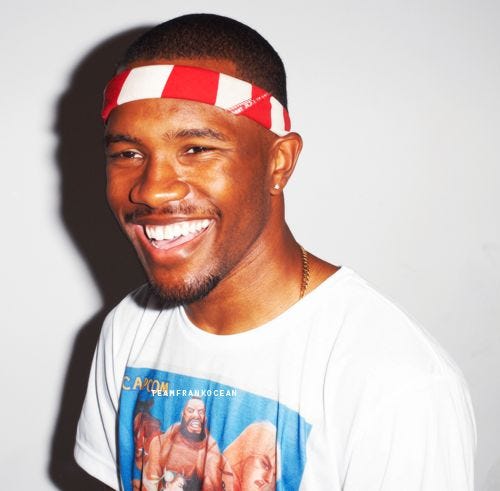
Frank Ocean changed everything with a Tumblr post.

Written by Jamari Shelton
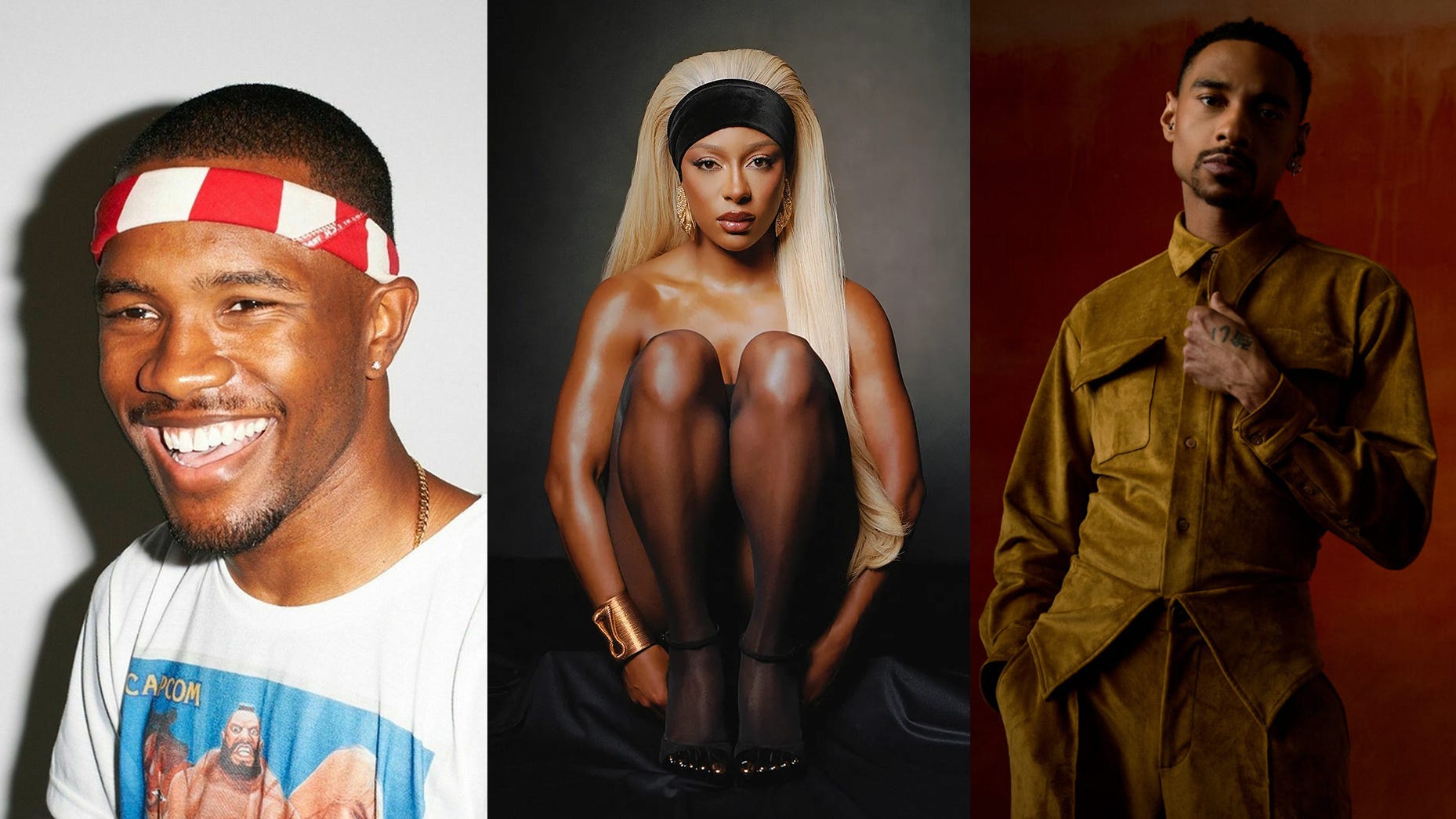
Frank Ocean changed everything with a Tumblr post.
But the music did the real heavy lifting. Just a boy, a car, and the internet that was heavily anchored to the ‘Tumblr’ aesthetic.
When channel ORANGE arrived in the heat of July 2012, I still remember where I was. I was 8, but I was old enough to understand what music meant to me. I had been diagnosed with depression, and music and writing were there to save me. Track 2 - Thinkin Bout You, was on my mind every day. I played it religiously. I remember one time I forgot the name of the song and went crazy trying to sing it to my cousin to help me find it.
But the album as a whole cracked open a door: for an album to be considered genre-bending and for Black artists to be open about their sexuality.
Just six days before channel ORANGE was set to drop, instead of a standard press release, Frank took to his Tumblr page on the Fourth of July and wrote a letter under a post titled “thank you’s.” The note wasn’t a calculated PR stunt. It was a beautifully written confession about falling in love with a man when he was between 19 and 20 years old.
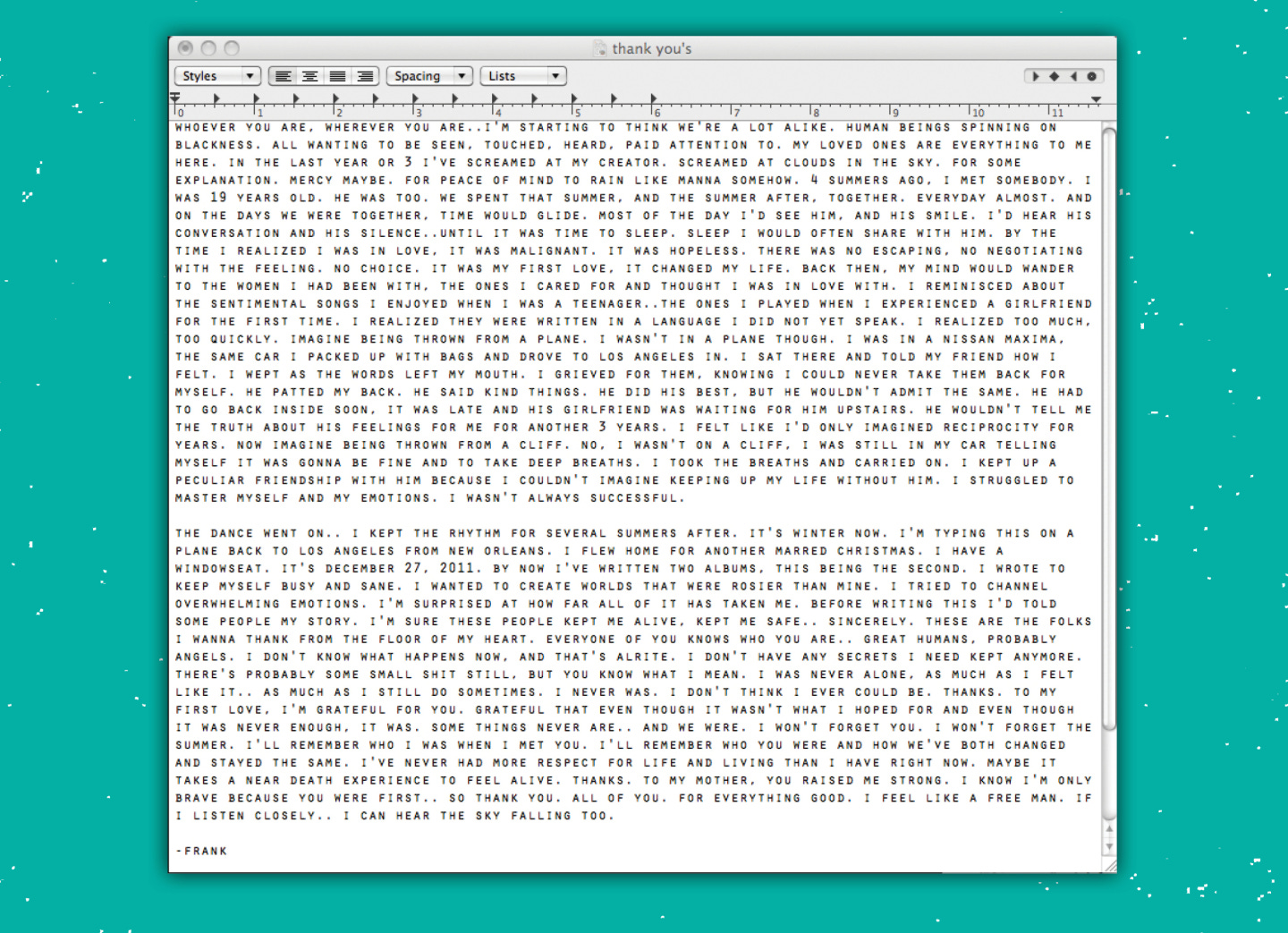
In a hip-hop and R&B landscape that was still deeply uncomfortable with anything outside the heteronormative lines, that missive felt like an earthquake. The internet caught fire, but the reaction wasn’t the usual gossip—it was a massive wave of support that ended up giving a whole generation of people the courage to finally tell their own stories. By the time the physical CDs hit shelves through Def Jam a couple of weeks later, that letter was printed right there in the album booklet, making it a permanent part of the art.
I knew nothing about love at 8 years old, but hearing the album made me ecstatic about having a crush. It seemed like so much fun when you’re older and can relate.
What made the album a foundational pillar for LGBTQ+ visibility in Black music wasn’t that it was loud or preachy. It was the fact that Frank allowed queer romance to exist with the same cinematic, everyday beauty that straight artists had enjoyed for decades.
Before this moment, LGBTQ+ themes in mainstream urban music were often treated as a punchline, a taboo secret, or a tragedy. For example, Detroit rapper Eminem would often throw around offensive LGBTQ+ language in his music. Songs like ‘Criminal,’ to name one.
Frank completely flipped that script. He gave queer love a soundtrack that was undeniable, forcing a historically rigid industry to nod its head to stories it used to ignore.
LA Times music writer Gerrick D. Kennedy called it “the glass ceiling moment for music. Especially Black music, which has long been in desperate need of a voice like Ocean’s to break the layers of homophobia.” For ages, Hip-Hop and R&B operated under a strict code of hyper-masculinity and rigid heterosexuality.
You couldn’t say queer love stories wouldn’t sell, because channel ORANGE was a critical and commercial juggernaut. It debuted at number 2 on the US Billboard 200 chart, with 131,000 copies sold in its first week
Yet, despite the media trying to paint him as a political martyr or a neat little symbol for a movement, Frank resisted the easy labels. He didn’t want to be a talking point. He just wanted to write about his life, noting in his letter that he wrote the album simply “to keep myself busy and sane.” By refusing to let his identity be sensationalized, he did something even more radical: he made queer desire feel normal, everyday, and deeply human.
Love Without Posture
Take Durand Bernarr. If you’re like me and have been tracking him since he collabed with Kaytranada on “Freefall” (my plane take off anthem), and you already know he’s been in the music world for a minute. On that track, he sang about the terrifying, thrilling rush of letting your guard down and just dropping into love, but he did it with an effortless lightness that felt like a breath of fresh air.
What makes Durand such a massive force for LGBTQ+ representation in modern R&B is that he refuses to give you a sanitized, radio-friendly version of queer life. He even described himself as “the version of Little Richard that religion did not get to.” It’s a heavy statement, but when you think about it, it makes total sense.
For decades, Black queer pioneers had to tuck their identities away, camouflage their lyrics, or let the industry turn their flamboyance into a spectacle while stripping away their actual humanity.
Durand is avenging that history. On tracks like “Prepared,” he’s singing about “heated fellowship” between two men, casually debating who is going to submit to whom. He’s filling a void for a community that has spent years dancing and crying to love songs that weren’t actually written for them.
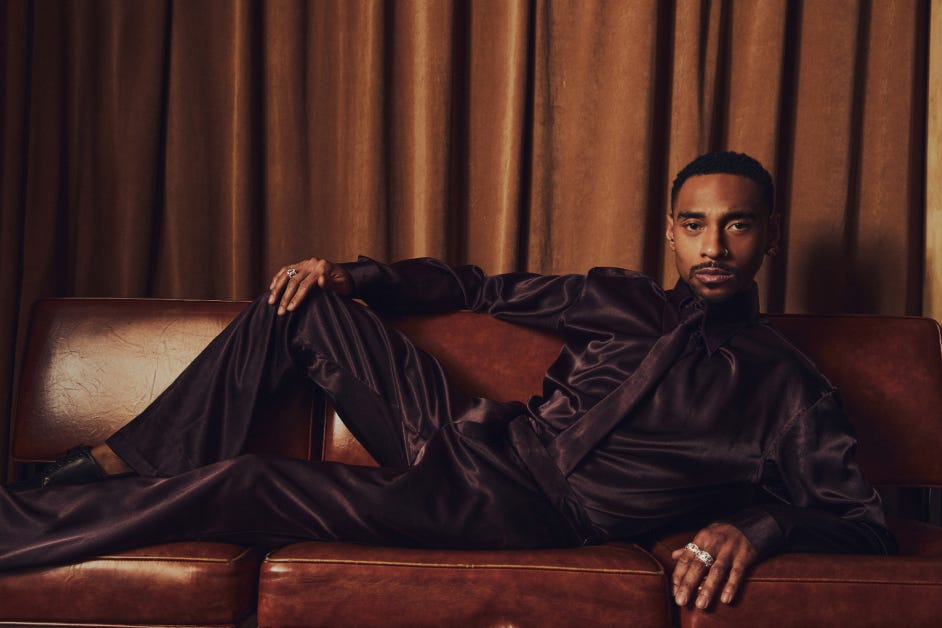
And the industry is finally forced to catch up to his fly. When he took home a Grammy this year for his album BLOOM, it wasn’t just a win for an independent artist who has been grinding on the road for over fourteen years; it was a massive moment of cultural visibility. Standing on that stage, he brought his full, unadulterated self into a room that historically didn’t know what to do with artists like him.
As he told Out Magazine afterward, it was about witnessing intersectionality being celebrated.
Pleasure on Our Own Terms
Victoria Monét, who has been holding down the foundations of modern R&B for years behind the scenes before stepping fully into her own spotlight. On tracks like “Touch Me,” she’s exploring the friction of attraction, the way a specific look from across the room can make everything else blur.
Her pen captures the nuance of bisexuality and fluid desire without making it a spectacle for the male gaze, which is a tightrope that Black women in music have had to walk for far too long.
During her JAGUAR II tour, I got to see her live at the Chicago House of Blues, where she performed one of my all-time favorites, ‘(F)riend (U) (C)an (K)eep’. Her performance included a deeply intimate and sensual moment between her and another Black female dancer.
What makes Victoria a vital anchor for representation in R&B is how beautifully normal she makes fluid love feel. When she officially came out as bisexual on X back in 2018 in a rant, she just let her fans in on her truth, later telling Gay Times, “If I should be successful, I don’t want to be successful based on someone’s imaginary view of me.”
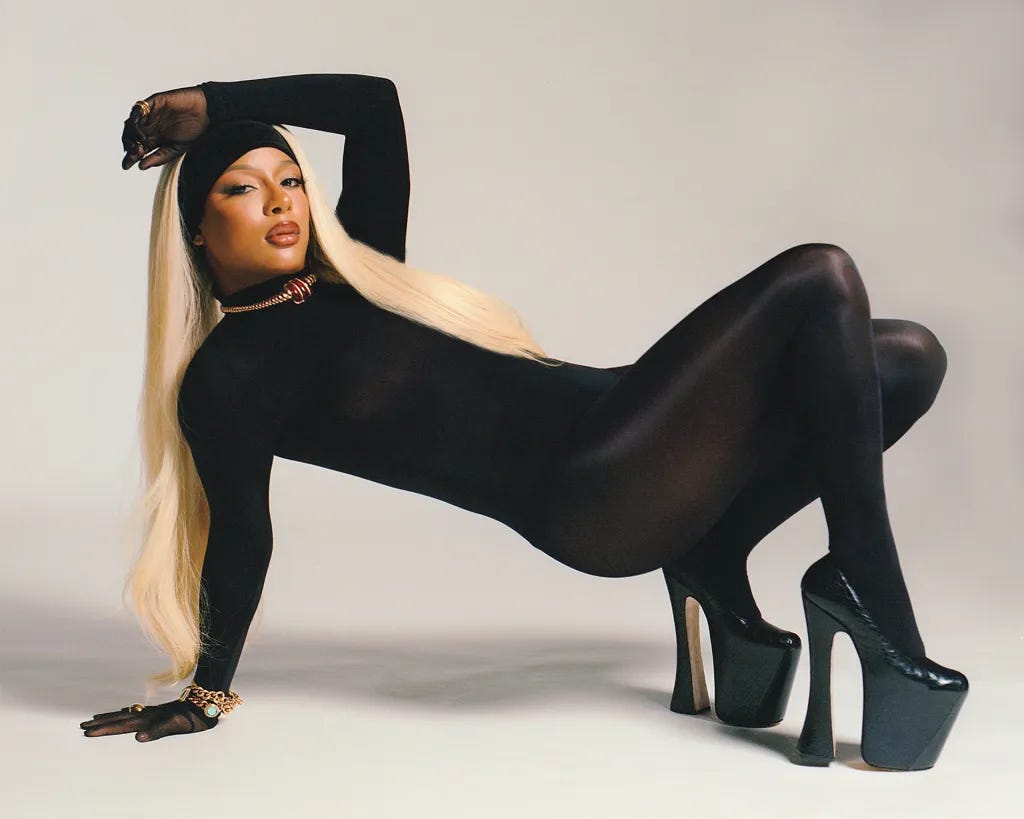
She’s been extremely open about her bisexual identity through her music. In her 2019 song “Monopoly,” featuring Ariana Grande, she sings: “I like women and men.”
Historically, the music industry has treated bisexual women like an exotic fantasy tailored for straight men, but Victoria completely strips that toxic dynamic away. When she sings about wanting a woman, it’s not for the cameras. The identity belongs entirely to her.
Look at the remix of “Touch Me” with Kehlani, also her former partner. They mapped out the heat of a connection with a level of care and mutual respect that you only get when two women truly see each other.
Even with ‘Hate the Club’ from Kehlani’s 2020 album It Was Good Until It Wasn’t. While it was long after their relationship had ended, Kehlani sang “Drunk when I call you Monet, begging you to walk me out. Say you miss, well, I need proof. I came all this way to see you.”
By the time she swept the Grammys for Jaguar II, it felt like a massive victory for the community. She wasn’t just winning for her incredible pen or her live arrangements; she was winning as a fully visible, unapologetically bisexual Black mother who refused to compromise her identity to get to the top.
Jamari Shelton is a Chicago-based entertainment writer and pop culture enthusiast covering breaking celebrity news, television, film, reality TV, and the internet moments everyone can’t stop talking about. She recently graduated from Columbia College Chicago with a degree in Broadcast Journalism, and is passionate about telling stories that inform, entertain, and spark conversation.
I really recommend checking out neen bowen. she’s an incredibly talented lesbian rnb artist that has been holding my headphones hostage for years and was a core part of my queer awakening. she hasn’t really caught a big break yet but she’s really got it
I was saying to my brother queer artists are carrying real life R&B and not whatever it is Summer Walker does.