

Kenyon Dixon Is Done Running Away
Our Ego Issue cover star Kenyon Dixon talks ego as a passenger, the creative journey of creating his new album 'EGO RUINS EVERYTHING,' and the state of R&B music in 2026.



There’s a bargain at the center of R&B that acts as an unwritten rule or truth.
The man sings. He comes apart while he does it. And we love him more for the coming apart — not less, never less. That’s the deal. K-Ci Hailey built a whole career with it. Jodeci put out “Cry For You,” and a generation of grown men learned that the fastest road to forgiveness was to make the begging sound expensive. Tank inherited it. Tyrese inherited it. Keith Sweat, Sisqo, Boyz II Men, the list goes on. Every live show where somebody drops to a knee is that same contract being honored in public, thirty years later, by men who were teenagers when it was signed.
Kenyon Dixon knows the contract. Kenyon Dixon is the contract, or has been, for a decade. The guy you call when you want the harmony stacked right, the writer other artists borrow their best from, the living argument that quality R&B never went anywhere.
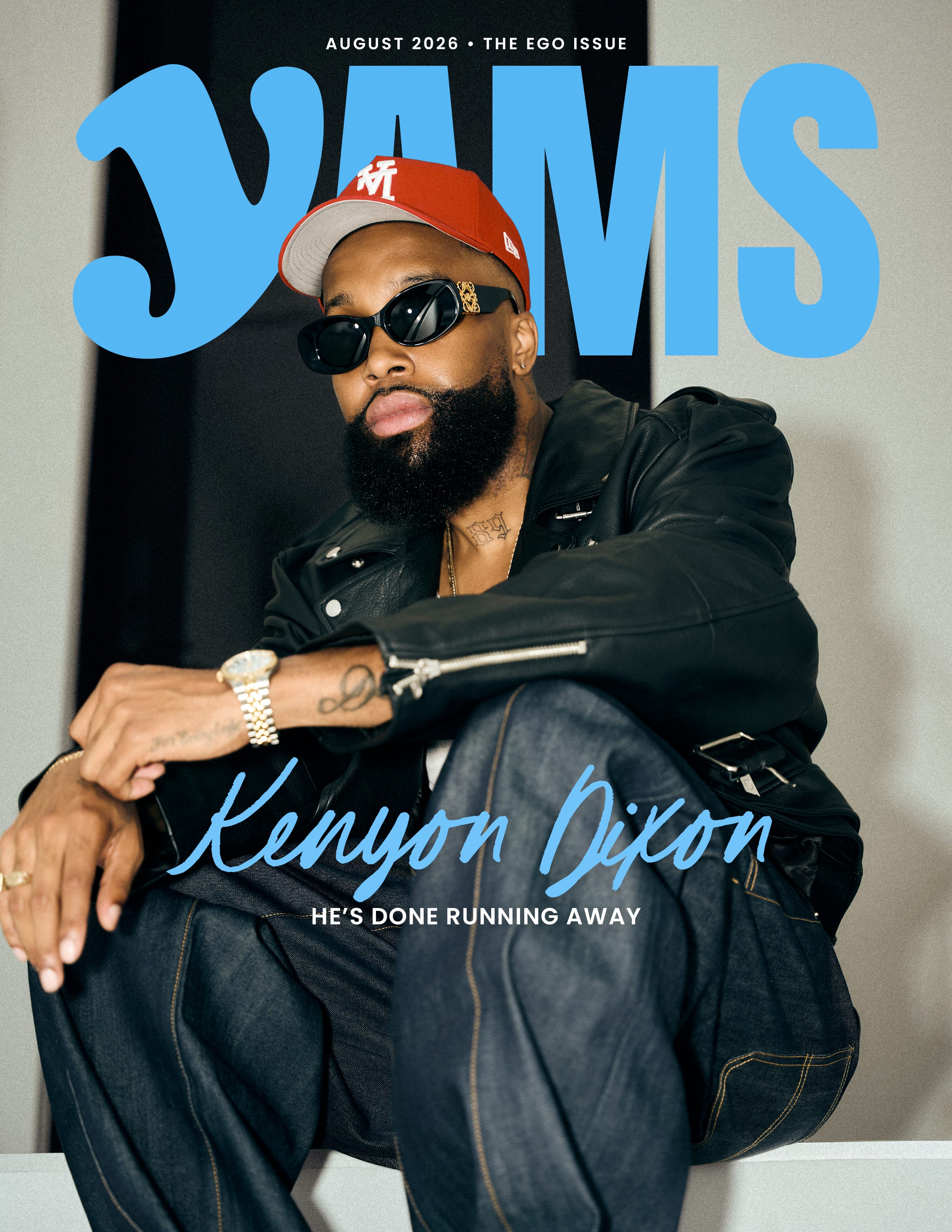
So the most interesting thing he’s ever done is rethink it. “No Jodeci” landed a few weeks ahead of the new album EGO RUINS EVERYTHING, and it is not a hard-guy record, though it might get filed that way by people who only heard the hook. It’s a man narrating his own vulnerabilities in real time.
“It’s about saying, like, you’re admitting to wanting to be vulnerable,” Kenyon says, “and admitting to all of the things that would make you a yearner. And saying, ‘Yeah, I miss you. I miss these times. I love you. I wish things could be different. However, I’m in a space right now where I’m getting a lot of validation, and people expect me to be a certain thing. So unfortunately for the both of us, I can’t really give you what you know you deserve right now, because I prefer to be ‘the man’ and play into what other people think.’”
He pauses. Then he puts the whole album in perspective in one single sentence. “My ego won’t let me be as honest as we know that I should be.”
Somewhere online this week, somebody is arguing that R&B lost its yearning. That the men of R&B aren’t singing like they used to. Kenyon made a record about why. But he also shows you that if you pay close enough attention, everything that people are searching for is right in front of their faces.
Putting Ego In The Backseat
Here is where a lesser album would go: ego is bad, kill your ego, healing arc, credits.
Kenyon isn’t interested in that. He gave the record a title you can print on a shirt. He’ll tell you flat out that EGO RUINS EVERYTHING is “the hook,” and he says the word the way a songwriter says it, meaning the part that gets you in the door — but the thesis underneath is more complex than a t-shirt ever could be.
“I think ego has its benefits,” he says. “It protects you. It helps you navigate through a bunch of crazy stuff. So ego itself is not terrible.”
Then the line I’ve been repeating all week:
“Don’t let ego be the driver in the vehicle. Teach ego what to do. Put it in the backseat.”
That’s not self-help. That’s a man with life experience, who has been independent his entire career, has five Grammy nominations, and has had to be his own hype man every single morning for ten years — telling you that the voice which got him out of bed is the same voice that will wreck his relationships if he ever hands it the keys.

Twenty-one tracks. Zero features. The new album follows a character who gets asked one question in the opening four seconds (“when was the last time you were happy?”) and spends 49 minutes finding out how to articulate that answer.
The Detour That Paid Off
This album was supposed to arrive two years ago. Then Terrace Martin called about making something together, and EGO RUINS EVERYTHING got put on pause. Come As You Are came out instead, and picked up two Grammy nominations, and Kenyon says in hindsight that getting delayed was the best thing that could have happened — not because of the hardware, but because of what it did to his listeners’ ears.

“Come As You Are was a lot different,” he says. “There was a very progressive R&B, jazz, hip-hop influence, which is something fans hadn’t heard from me — but it was something that I’m well-versed in. It’s just that I had never done any music like that. So following up with a project like this, they’re now already prepared for the fact that they know that I can be versatile.”
Read that again, because he’s being gracious about something that bothers him, and bothers most artists to a degree. Being the “classic R&B guy” is a beautiful cage. The audience arrives already loving you. They also arrive with a list of demands.
“People come to me for a certain caliber of R&B,” he says. “I love that they know to come to me for a certain quality of music. But then it makes you feel like you can’t explore or make anything else.”
Every great R&B singer eventually meets this dilemma. D’Angelo met it. Musiq Soulchild met it. Mary J. Blige. The ones who survive it are the ones who figure out that their audience’s loyalty is not actually to a sound — it’s to a feeling, and the feeling can be re-housed.
Doing Whatever The Story Required
The real shift on this album isn’t sonic. It’s a rule.
“I told myself that I would do whatever the story required this time.”
Understand who is saying this. Kenyon Dixon arranges vocals. He’s the guy in the room who hears the third harmony nobody else clocked. His reputation is built on craft that musicians can hear, on being unimpeachable; never once turning in something messy.
And he decided the craft doesn’t run the room anymore.
“Usually I’m all about having a body of work and a collection of quality songs that are all about being pleasing to the craft and the ear, and to those who know music,” he says. “This time, I’m not making music to appease musicians. It’s not for people who understand music theory and all this stuff. I just wanna make music that makes sense for the story.” This album is for the casual R&B fan, just as much as the musicians who grew up in church choirs as Kenyon did.
Which is how “THE MAN” exists — a record with a knock and a strut that a lot of his people did not see coming, and which is, full disclosure, the one I’ve told him about being one of my favorites when he sent me the project a couple of months back. His producer Frank Rose sent him the track, and Kenyon says he knew it was needed immediately.
“I already knew what the story was based on what I felt from listening to the production,” he says. “It just felt necessary. I don’t think EGO RUINS EVERYTHING would be the same without that track, because there is a certain swag there that sets everything up nicely.”
The one he keeps coming back to himself is “NIGHTS LIKE THESE (COME THROUGH),” and his reasoning is the most quietly radical thing he said to me. He is a nostalgia artist. He has built entire projects on the study of eras. He is also completely done with nostalgia as impersonation.
“What I’m big on with nostalgia is recreating the feeling, not the sound.”
“It feels like a record from the early 2000s that’s like Little Brother, or like Slum Village, Q-Tip-esque. It’s in that hip-hop world. Even with where I’ve played around with nostalgia, I don’t think I’ve ever been able to get a record with that feeling.”
For the record, he will fight you about the “best R&B era” conversation. “Even between ‘90s and early 2000s, I’ll fight to the mill to say that I think early 2000s is better. For my own personal reasons.”
Correct answer, incidentally. But that’s a different story.
He’s Done Running
The four RUNNING interludes — a motif that recurs throughout the album, which he explains was meant to let his fans know a bad decision was coming whenever it surfaced — were built the day before he turned the album in.
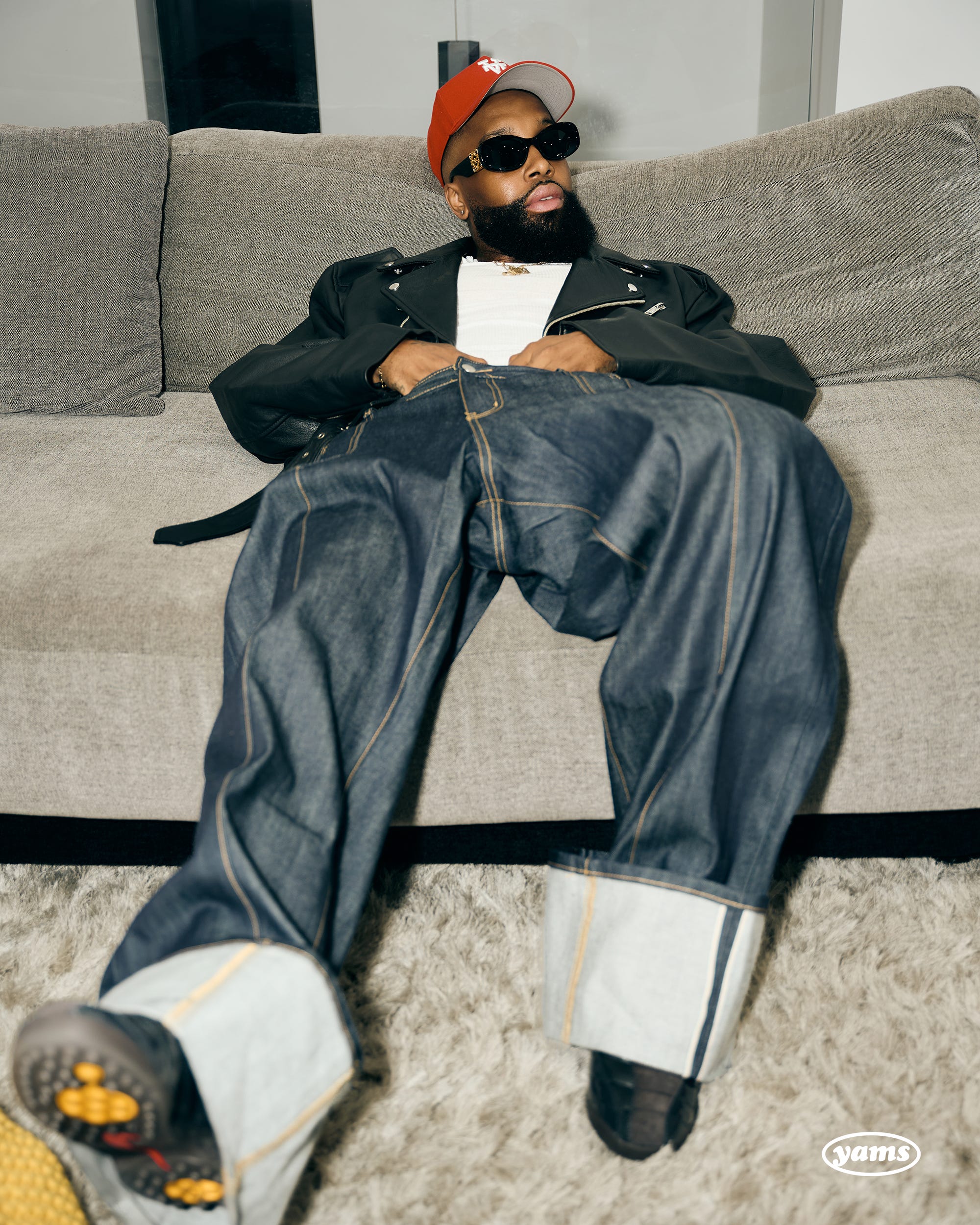
The original plan was narration by G.G. Townson, an actress and one of his closest friends. She opens the album with the question that haunts the whole thing, and she was supposed to carry interludes throughout. Then he thought about it and realized he’d done something adjacent on The R&B You Love.
“So being in a rush, one, and not having much time, but also trying to be creative, I was like — I’m looking at this as a concept album, and I want it to be cinematic. What’s something that happens in movies?” he says. “I started thinking about a familiar image that you would see repeated throughout a movie. So I said, how do I do that sonically? And I’m like, oh — maybe I just take something that they’ve heard, and we just score it instead.”
But here’s the detail that actually tells you who he is, and most won’t consciously catch it on a first listen.
“It was important to know with the scoring that as that interlude went on throughout the album, the frequency of it changed,” he says. “So by the time you hear it the last time, it’s a lot brighter and lighter. Because now there’s less running. There’s more acceptance instead of running away from it.”
He was under the gun, out of time, improvising the structural spine of a 21-track album — and he still built the emotional arc into the timbre of a thirty-second cue that most listeners will register only in their chest.
That’s the guy. The panic just made him quicker.
So, When Was The Last Time You Were Happy?
The album opens with a woman asking that question. Forty-nine minutes later, the character still hasn’t answered. So I asked him.
He laughed at the contrast, because the truth is the exact inverse of what the record sounds like: he was happy the entire time he made it.
“But it’s because I had already done the work. It was very retrospective, and it showed me a lot of lessons and a lot of progress, because I was harping on thoughts and building on creative thoughts that I actually worked through. So I had a lot of appreciation for myself, because I’m looking at the story and I’m like, ooh, I remember when I felt like that. Or, I remember when you did that. It’s crazy to be on the other side of that.”

This is the part that separates a confessional record from a constructed one, and Kenyon is careful about it in a way I wish more artists were. We’ve spent a decade demanding that R&B be diaristic — that every song be a receipt, that we name-check the ex we saw on Instagram in months past. He’s pushing back, gently, on behalf of craft.
“There’s still the art of being creative, so you still have to turn that into a story and make it interesting for people,” he says. “Because not everybody’s sole experience is something that people are interested in. So you have to find ways to be like, okay — what would make somebody wanna hear this?”
And then, the line that makes the whole album communal instead of confessional: “My story might be some of your story. It’s some of everybody else’s.”
There Is No Quality Problem in R&B
Ask most people who love R&B this much about the state of R&B, and you get a eulogy. I bring up the fact that some of his peers see R&B as something they need to escape to achieve “bigger” success. Meanwhile, an artist like Kelela (who is far more alternative-leaning than some of her traditional R&B counterparts) treats R&B as home, and treats herself as a champion of the genre.
Kenyon is on the Kelela side of things.

“I think it is unfortunate, because I do think R&B is looked at as lesser than in comparison to the other genres,” he says. “But if we break it down, it really comes to the fact that it has a lack of support. R&B doesn’t get supported as much, so I think people are afraid to have to work a little harder to get the support.”
“When we look at R&B and soul back in the day, yeah, there was a higher rate of quality music in theory — but you also didn’t have the access to technology as you do now. There’s probably more quality music now than there was back in the day. It’s just that now you have a lot more music that you gotta sift through.”
And the kicker, which every nostalgia merchant should be forced to read aloud:
“Even back in the day, when we talk about how great music was in the ‘90s and 2000s — there was bad music there too. That’s what made the good music so good. You had the contrast. Not everybody was making the music that we love.”
The prescription follows naturally. Protect the weirdos.
“I like to champion original ideas, because what I’ve learned being in this industry is the stuff that they laugh at today will be the thing that’s moving the needle tomorrow. You gotta just kinda let people be creative, because that’s how we keep the genre moving. If everybody is making the same thing, it’s not gonna go anywhere.”
So What Can You Offer Me?
The last time we spoke on the record, he was sitting in on label meetings, thinking about what a major-label future could look like for him.
Today, he is still independent and is one of the more successful independent acts in R&B, thanks to his work ethic, quality music, and willingness to promote himself. I wanted to know what he learned in those rooms.

He isn’t anti-label, and he’s precise about who the machine actually works for. “I think labels are for superstars. So if that’s what your plan is, I think it works for you. I’ve built something so specific that it can get me consistent results for the rest of my life, and I realize I might compromise it by going to a label. Because when I sit in these meetings, and they tell me what they can offer, alot of times it’s stuff that I’ve already gotten myself independently.”
“I run into major label reps, and they tell me how they wish that their label artists understood the industry the way that I do. And that’s alarming to me. Like — what do you mean? If I’m gonna come to you, what do you mean you wish they were working the way I’m working? So what can you offer me?”
He’s watched the other side of that door too many times to be seduced by it.
“Look how many dope artists we get a project from and never another project,” he says. “They sign to a label, they don’t have proper motion, they don’t understand what it looks like to have to promote their own stuff. And they don’t understand that the labels expect them to still do the work and are hoping that something pops off on its own. And next thing you know, they’re dropped from the label and uninspired, and they don’t wanna make any more music.”
A beat.
“It’s a lot of dope artists that that keeps happening to. So I’m like — yeah, I think I’m good.”
What makes EGO RUINS EVERYTHING a great album for me isn’t the concept; it’s the discipline. A man who could coast on a golden voice instead built a room with doors, put a character in it, and trusted us to notice when the light changed. That’s a harder album to make than a good one, and it’s a better one to live inside — the kind you finish and immediately restart to catch what the interludes were telling you the first time.
A decade in, still independent, Kenyon Dixon keeps earning the respect of everybody in this genre for the least glamorous reason there is. He does the work that most don’t want to do. And then he does more of it.